Pick the goal before the tool. The seven below are where researchers consistently report a real time saving and a defensible quality improvement.
SECTION OBJECTIVES
Match research tasks to AI capabilities they actually fit.
Recognise the failure modes that come from applying AI to the thinking, not the work around the thinking.
Articulate a one-sentence rule for when to use AI in your own research practice.
Mindset
Get the mindset right
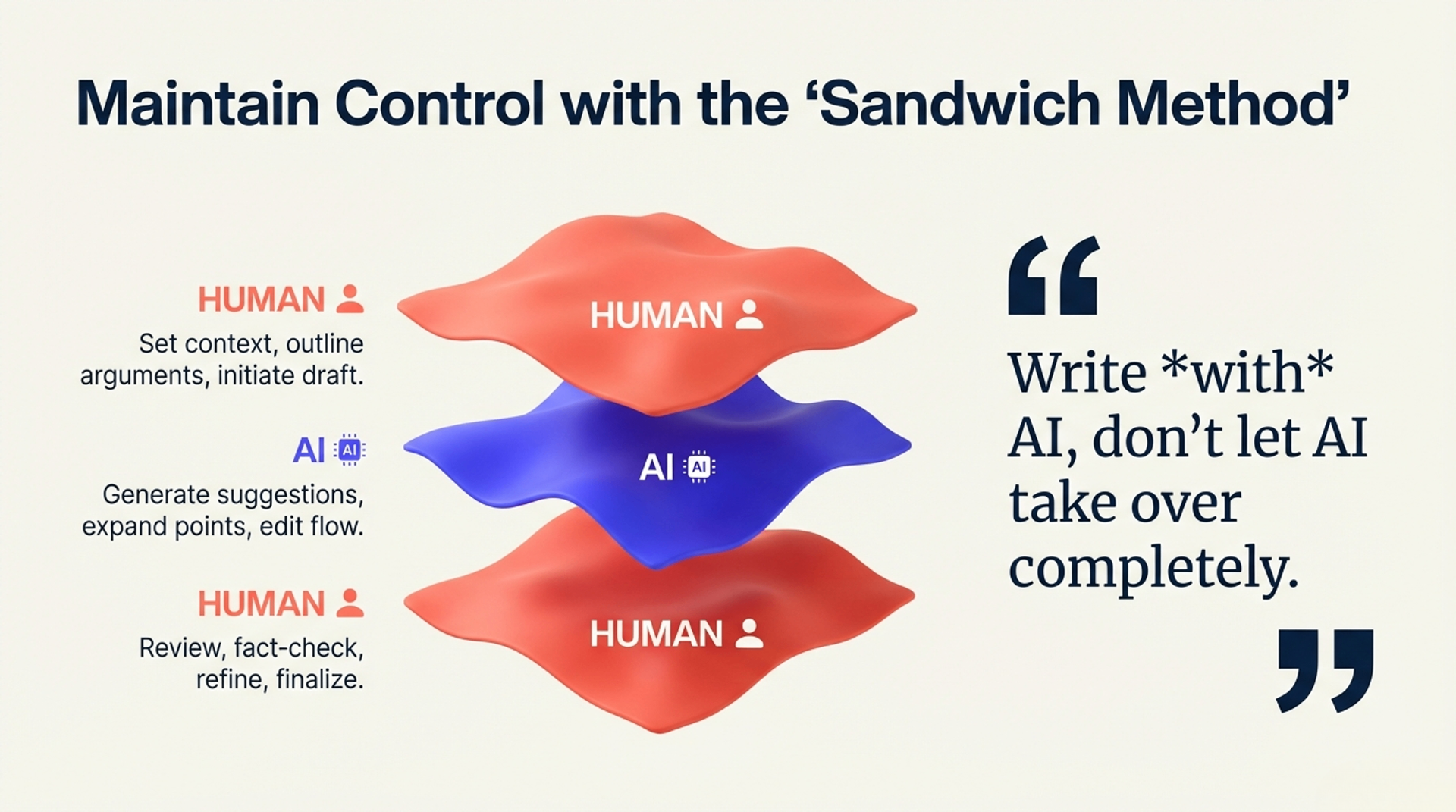
We want to use AI to help us improve our research, not only in terms of speed but also quality. Human–AI partnership is key, rather than letting AI do everything.
The Sandwich Method — write with AI, don't let AI take over completely.
Before picking a tool, pick a goal. Most disappointment with AI in research comes from applying it to the wrong stage of the work. The seven goals below are the ones where researchers consistently report a real time saving and a defensible quality improvement.
01Literature triage
Good fit
Scanning 100 abstracts down to the 15 worth reading; building a first-pass concept map of an unfamiliar sub-field; finding the 3 most-cited critiques of a position.
Poor fit
Replacing close reading of the papers you actually cite. Treat AI triage as a filter, not a substitute.
02Hypothesis and design generation
Good fit
Brainstorming alternative explanations for a finding, stress-testing a design against threats to validity, generating 'what would falsify this?' lists.
Poor fit
Outsourcing the theoretical commitment. Hypotheses you can't defend in your own words are not yours.
03Methodology critique
Good fit
Pre-flighting your own methods section, anticipating Reviewer 2, checking that the analysis plan matches the research question, surfacing missing pre-registration elements.
Poor fit
Using critique to gild a fundamentally weak design. AI will critique inside the frame you give it.
04Drafting and editing
Good fit
Restructuring a messy intro, tightening verbose paragraphs, producing plain-language summaries, generating a first pass of an abstract from a finished paper.
Poor fit
Generating prose for fields you haven't done the thinking for. The tell is hedged generic sentences that say nothing specific.
05Teaching-material generation
Good fit
Drafting discussion questions from a reading, generating worked examples in your voice, producing accessible versions of complex figures, building rubrics from learning outcomes.
Poor fit
Generating lectures wholesale. Students notice. So do colleagues.
06Qualitative coding assistance
Good fit
First-pass thematic coding against a fixed codebook, surfacing candidate codes for human review, drafting analytic memos from coded extracts.
Poor fit
Final coding without human adjudication. Inter-coder reliability with an LLM as a coder is an open methodological question. Be transparent.
07Reviewer-style feedback
Good fit
Getting structured, fast feedback on a draft before you send it to a real colleague; pre-empting common reviewer concerns in your sub-field.
Poor fit
Using AI as the only reviewer. The signal is real but narrower than a human peer.
Watch for AI overclaim in its output
Even the best models tend to overstate what they have done and how certain they are. A summary will sound comprehensive when it only covered three of your eight sources. A literature scan will present five papers as "the key works" when it sampled what was easy to retrieve. A draft will frame a contested claim as settled.
Common overclaim patterns
Confident citations to papers that do not exist or do not say what is quoted.
"Comprehensive" reviews that silently drop sources the model could not access.
Statistical or methodological claims stated without the conditions they depend on.
Synthesis that smooths over genuine disagreement in the field.
How to push back
Ask the model to list what it did not check and where its evidence is weakest.
Require source-grounded answers and verify two or three citations yourself.
Ask for the strongest counter-argument before you accept a conclusion.
Treat the output as a first draft by a confident junior, not a finished result.